Marketplace App Development Cost: What Drives the Price
 MD Rakibul Islam RakibFull-stack developer, DevOps & Linux engineer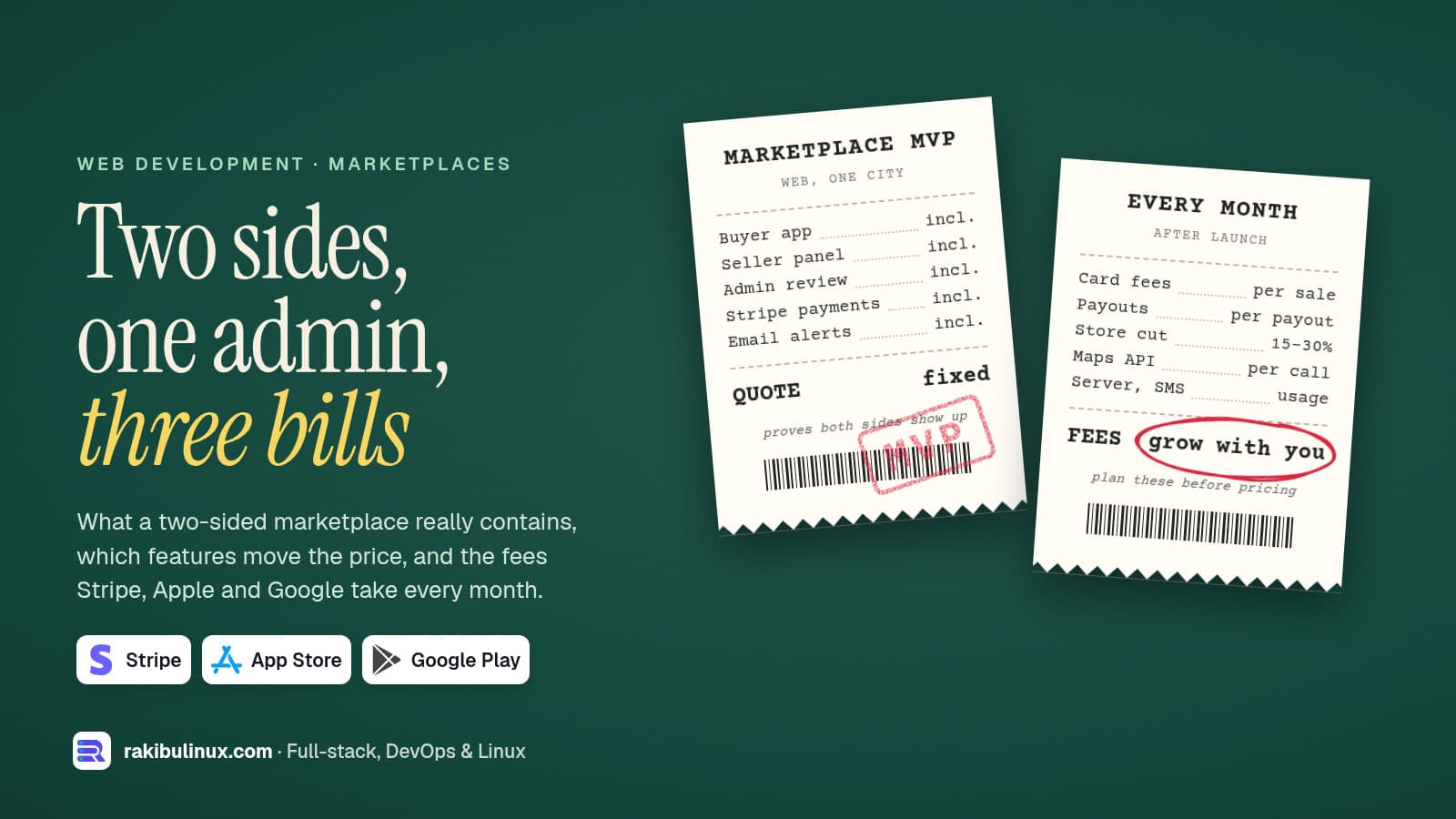
A marketplace app is three products in one: a buyer side, a seller side and an admin side. Payments, payouts and trust features move the price most.
Since mid-2024 I have worked on NETME, a Munich app where people meet in real cafés and bars, and venues pay to be part of it. It is a marketplace in the true sense: users on one side, venues on the other, the NETME team in the middle. Behind one app sit five codebases: iOS, Android, a website, a partner panel for venues and an admin panel, all on one API. Instead of an invented price table, here is what a real marketplace contains, what moves the cost, and the fees that keep coming after launch.
Key takeaways
- Count the sides. Buyers, sellers and admins each need their own screens, permissions and tests. That is most of the cost.
- Money is the riskiest part. Splitting payments, paying sellers out and handling refunds need a payment platform built for it, such as Stripe Connect.
- Trust features are not optional: reviews, reporting, moderation queues and approval flows keep a marketplace usable.
- Fees scale with success. Card fees, payout fees and app store commissions grow with every sale. Put them in the business model first.
- Launch small: one city or one category, web first, and manual admin work where code can wait.
What does a marketplace actually contain?
- The buyer side: sign-up, search and filters (often by location), listing pages, booking or checkout, messages, reviews, notifications and an account area.
- The seller side: onboarding and identity checks, a profile or listings editor with a preview, availability or stock, orders, payouts, and analytics. On NETME this is the partner panel, where a venue edits its profile, sees how it looks in the app, books ads and push campaigns, and follows impressions, clicks and invites on a daily chart.
- The admin side: approvals, moderation with reasons the seller can read, user and seller management, vouchers and plans, support messages, and reports. NETME's admin team approves or rejects every ad and push request, and the partner sees the reason.
- The engine underneath: payments and payouts, background jobs (expiries, reminders, clean-ups), real-time updates, file uploads, rate limits and spam protection.
If a quote only describes the buyer app, ask where the other two sides are.
The cost drivers, biggest first
1. Payments and payouts
A shop takes money. A marketplace takes money, keeps a commission and sends the rest to someone else, sometimes in another country, with refunds and disputes going the other way. You don't want to hold other people's money yourself. A platform like Stripe Connect handles seller onboarding, identity checks and payouts. The work on your side is the order and payment flow, the commission rules, webhooks that are safe to receive twice, and a ledger that explains every number to sellers.
2. Subscriptions and in-app purchases
Many marketplaces earn from plans as well as commissions. NETME has two kinds: venues pay for Starter, Business or Enterprise plans through Stripe, and the partner panel locks paid features when a plan expires. App users buy premium through the App Store or Google Play, and the API checks each purchase with Apple's and Google's servers before unlocking anything. A nightly job handles expiries. That is three billing systems to keep in sync, and it is work worth planning, not discovering.
3. Location and search
"Near me" means a geospatial index, a radius per feature and a place search. On NETME, place search goes through our own endpoint to the Google Places API and filters to venue types where people actually meet. Ads are matched inside a city-sized radius with MongoDB geospatial queries. Maps and Places APIs are billed per request, so caching matters.
4. Messaging and notifications
Buyers message sellers, sellers message support, and everyone expects push notifications. On NETME, partner and admin messages run on Firebase with images and documents, new ad requests appear live in both panels over Socket.io, and the app gets pushes through Firebase Cloud Messaging. Each channel is a feature with its own edge cases: offline users, unread counts and abuse.
5. Trust and safety
Reviews, reports, blocking, approval queues, rate limits on login and one-time codes, bot blocking, and account deletion that really removes a user's data everywhere. Skipping these saves time at launch, then costs far more when the first spam wave or data request arrives.
6. Native mobile apps
A web-first marketplace with a responsive design is cheaper to launch and change. Native apps add store review, push setup, in-app purchase rules and two more release pipelines. Build them once you know people come back.
The fees that come every month
These are the numbers to put in your business model before you set a commission. Check each provider's pricing page for your country, because rates differ by region.
- Card processing: a percentage plus a fixed amount per successful charge, set by Stripe or your local processor.
- Stripe Connect: if you let Stripe handle pricing for your sellers, there are no extra platform fees. If you handle pricing yourself, Stripe lists $2 per monthly active account (a month in which payouts are sent) and 0.25% + 25¢ per payout.
- App store commission: Apple's Small Business Program charges 15% on paid apps and in-app purchases for developers with up to $1 million in proceeds a year (30% is the standard rate). Google Play charges 15% on the first $1 million a year and 15% on auto-renewing subscriptions. Rates differ in some regions, including the EU.
- Maps and places: billed per request above any free allowance.
- SMS, email and push: one-time codes and alerts cost per message.
- Servers, storage and backups, plus a maintenance budget for OS updates, library updates and new store requirements.
Which payment path applies is not your choice alone. Apple's App Review Guidelines (section 3.1.3(e)) say that physical goods and services used outside the app must use payment methods other than in-app purchase. A café booking or a cleaning job goes through Stripe; premium features inside the app go through the stores. Get this right in the design, or app review will send you back.
How to launch a marketplace without overbuilding
- One city or one category. A marketplace lives or dies on having enough supply in one place. Narrow beats wide.
- Web first. A fast responsive web app proves demand. Native apps come next.
- Manual where possible. Admins can approve sellers, issue refunds and match edge cases by hand at first. Automate what repeats.
- Payments done properly from day one. This is the one area not to fake. Use Stripe Connect or similar, not a spreadsheet of payouts.
- Measure both sides. Sign-ups on each side, first transaction, repeat transaction. Build the next feature for whichever side is stuck.
Questions to ask before you sign with a developer
- Where are the seller panel and the admin panel in this quote?
- How are payouts, refunds and disputes handled, and who holds the money?
- What happens when a webhook arrives twice or a payment confirms twice?
- Which billing system handles in-app purchases, and how is a purchase verified?
- Who owns the code, the store accounts and the Stripe account? (You should.) My hiring checklist has the full list.
Frequently asked questions
How much does it cost to build a marketplace app?
It depends on the number of sides, the payment flow and whether you need native apps, far more than on screen count. A web MVP for one city with buyer, seller and admin sides costs a fraction of a full iOS, Android and web platform. Get a fixed quote against a written feature list, not a range from a calculator.
Should a marketplace use Stripe Connect?
For most startups, yes, or a similar platform in your region. It handles seller onboarding, identity checks and payouts, so you don't hold other people's money yourself. Plan its per-account and per-payout fees if you control pricing.
Do I have to use Apple in-app purchase in my marketplace app?
Not for physical goods and real-world services used outside the app; Apple's guidelines say those must use other payment methods. Digital features and content unlocked inside the app generally must use in-app purchase. Read the current guidelines before you design the flow.
What features can a marketplace MVP skip?
Native apps, advanced analytics, automatic dispute handling, multiple currencies and complex search can usually wait. Payments, basic reviews, reporting and an admin approval flow should not.
How long does it take to build a marketplace MVP?
A focused web MVP takes weeks, not months, when the scope is written down and kept to one city or category. Native apps, multiple payment methods and many seller types add time.
Planning a marketplace?
I build marketplace platforms end to end: buyer apps, seller and admin panels, Stripe payments and payouts, in-app purchases and the API behind them. See my web development services or tell me about your idea and get a written scope with a fixed price.

Written by
MD Rakibul Islam Rakib
Full-stack developer, DevOps engineer and Linux system administrator with 5+ years of production experience. I deploy, harden and fix servers and web apps for clients worldwide, and everything in this article runs on real servers I manage, including this site.
- marketplace app development cost
- build a marketplace app
- two-sided marketplace
- stripe connect fees
- app store commission
- marketplace mvp
- partner panel