Available for new projects
Full-stack developer & DevOps engineer who builds fast, reliable web apps
I'm Rakib. I design, build and deploy production-ready products with Next.js, NestJS and PostgreSQL, then run them on Docker, AWS and Linux servers. One engineer, from first commit to production.
- Free consultation
- Fixed-price quotes
- Reply within 24 hours

5.0/5from 4 client reviews

MD Rakibul Islam Rakib
Full-stack · DevOps · Linux admin
The stack I ship with
- Next.js
- React
- TypeScript
- Node.js
- NestJS
- Tailwind CSS
- PostgreSQL
- MongoDB
- Prisma
- Redis
- Docker
- Kubernetes
- AWS
- GitHub Actions
- Nginx
- Stripe
- Linux
5+Years in production
50+Projects shipped
24hAverage reply time
GlobalRemote clients
Services
Everything your product needs, from code to cloud
One technical partner for the app, the infrastructure and the servers underneath, instead of three vendors pointing at each other.
Web app development
SaaS products, dashboards and marketplaces built end to end, with auth, payments, real-time features and an admin panel your team can actually use.
- Next.js & React frontends
- NestJS & Node.js APIs
- PostgreSQL & Prisma
- Stripe payments
DevOps & cloud
Containerised deployments and CI/CD that are repeatable, monitored and easy to roll back.
- Docker & Kubernetes
- AWS (EC2, S3, EKS)
- GitHub Actions CI/CD
Linux administration
Setup, hardening, migrations and backups for the servers your business runs on.
- Ubuntu & Debian
- Security hardening
- Backups & migrations
Website & UI design
Fast, responsive marketing sites and Figma-to-code builds that look sharp on every screen.
- Figma to Next.js
- Responsive & accessible
- SEO-ready pages
Maintenance & support
Ongoing updates, monitoring and fixes, so your product keeps running while you focus on the business.
- Bug fixes & updates
- Uptime monitoring
- Performance tuning
Fixed-price packages
Clear scope, upfront price and delivery time. Start this week.
- Website Design
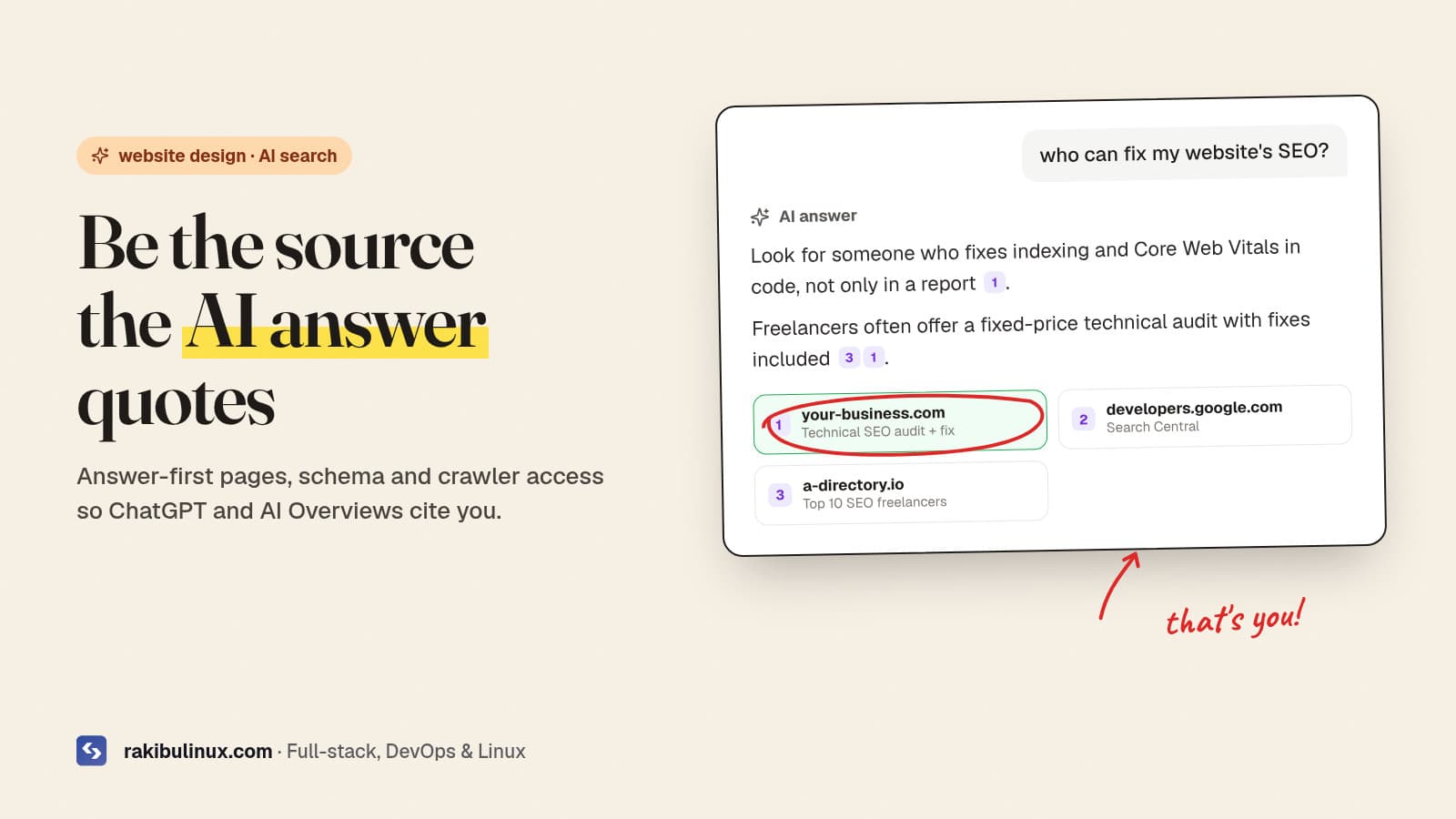
AI Search Optimization: Get Your Business Cited by ChatGPT, Perplexity and Google AI Overviews
5-day delivery2 revisionsStarting at$249
View - Website Design
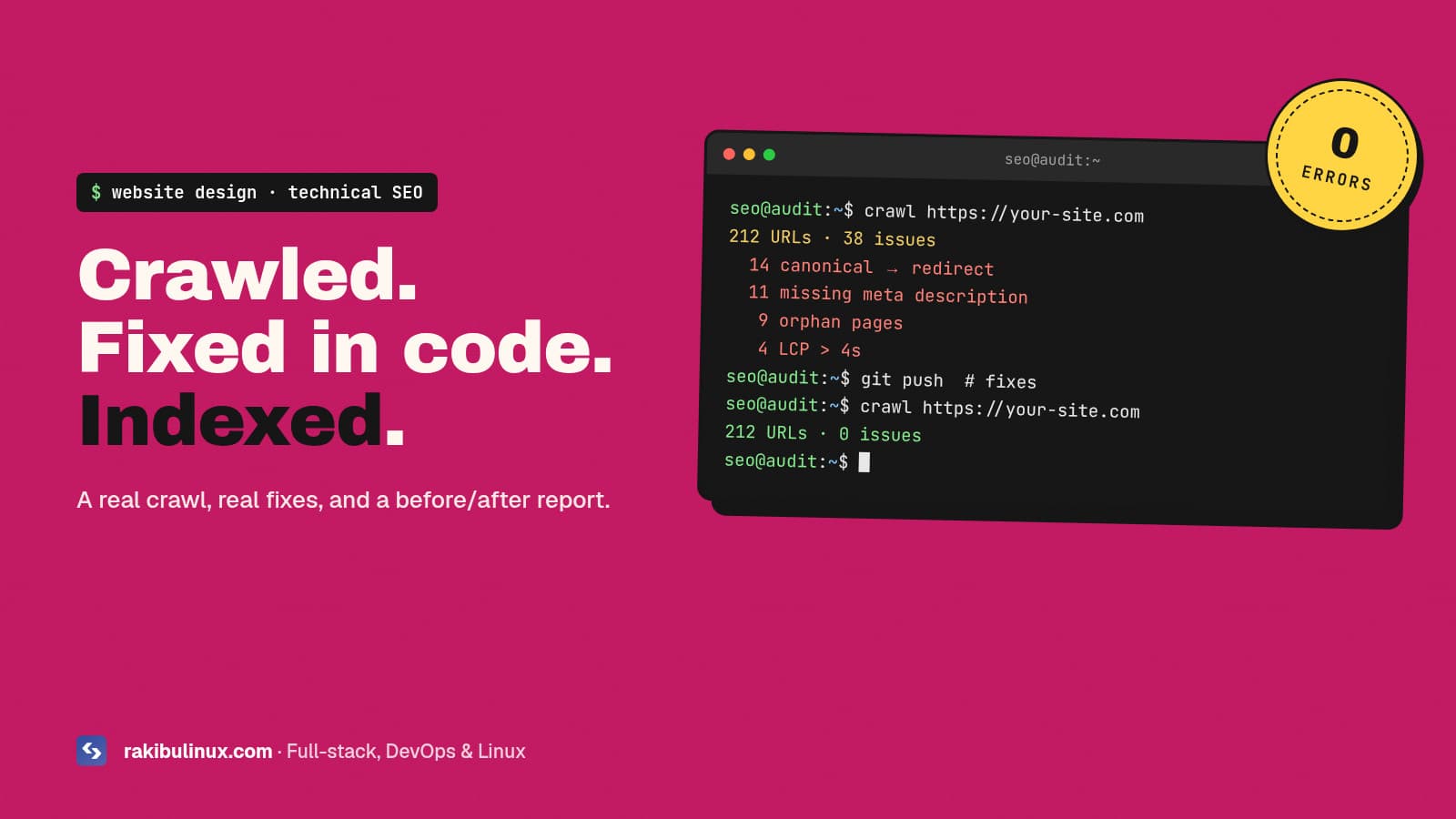
Technical SEO Audit and Fix: Indexing, Speed, Schema and Core Web Vitals
4-day delivery2 revisionsStarting at$199
View - Website Design
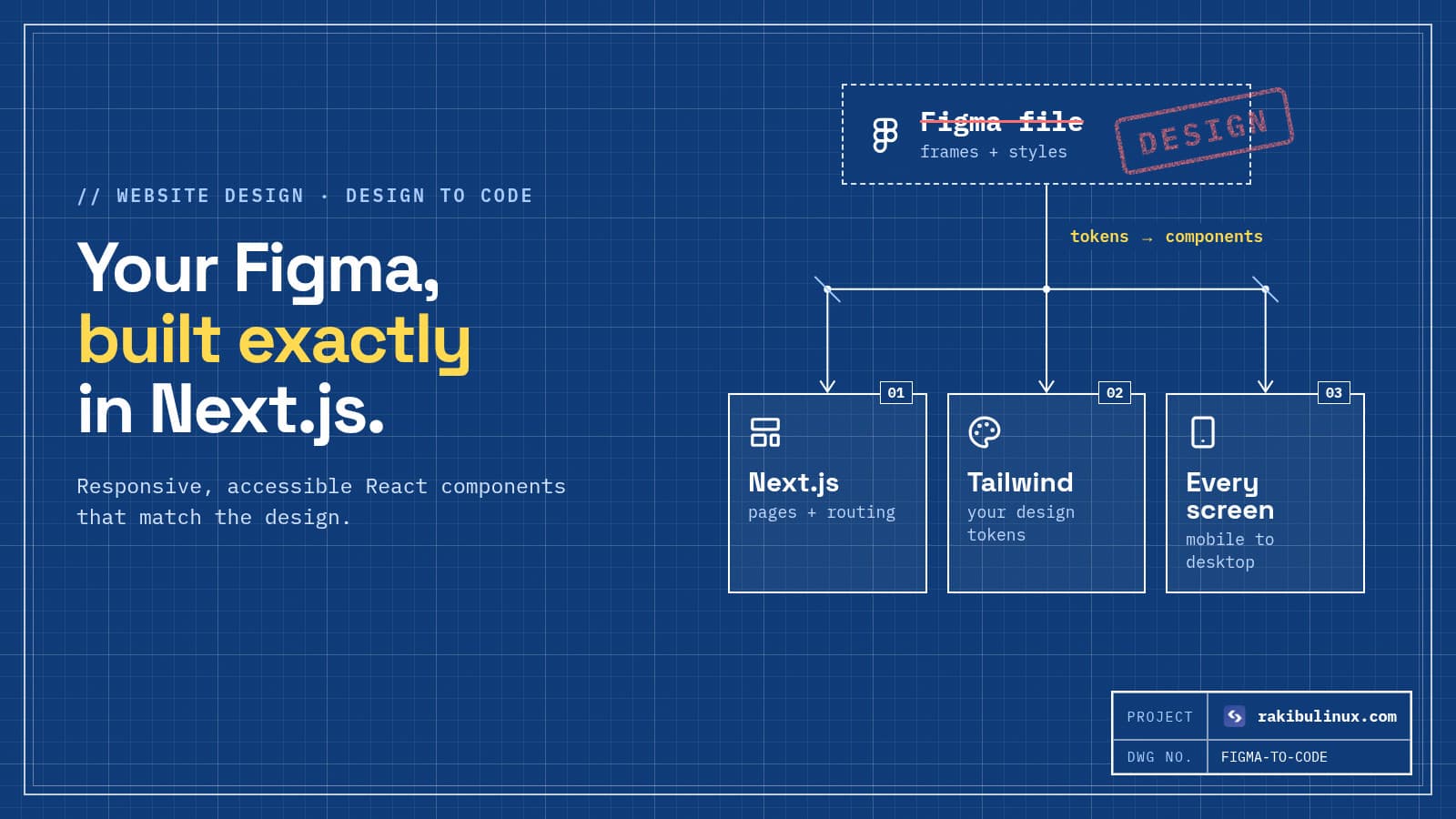
Figma to Next.js, React and Tailwind CSS: Pixel-Perfect and Responsive
5-day delivery3 revisionsStarting at$249
View
Why work with me
Why clients hire me
Agency-level quality without the agency overhead or the freelancer guesswork.
One engineer, whole stack
Frontend, backend, database and servers handled by the same person. No hand-offs, no finger-pointing.
Fixed quotes, no surprises
You get a written scope, milestones and a fixed price before any work starts.
Built to be fast
Performance-first Next.js builds with caching and lean pages that rank well and convert.
Secure by default
Hardened servers, proper auth, SSL and backups. Production habits from years of Linux ops.
Clean handover
Documentation and full access to your code, servers and accounts. You own everything.
Easy to work with
Clear updates, replies within 24 hours and calls scheduled around your time zone.
Selected work
Products I've built and shipped
Real applications in production: the stack, the features and the problems they solve.
Warehouse Management System (3PL WMS)
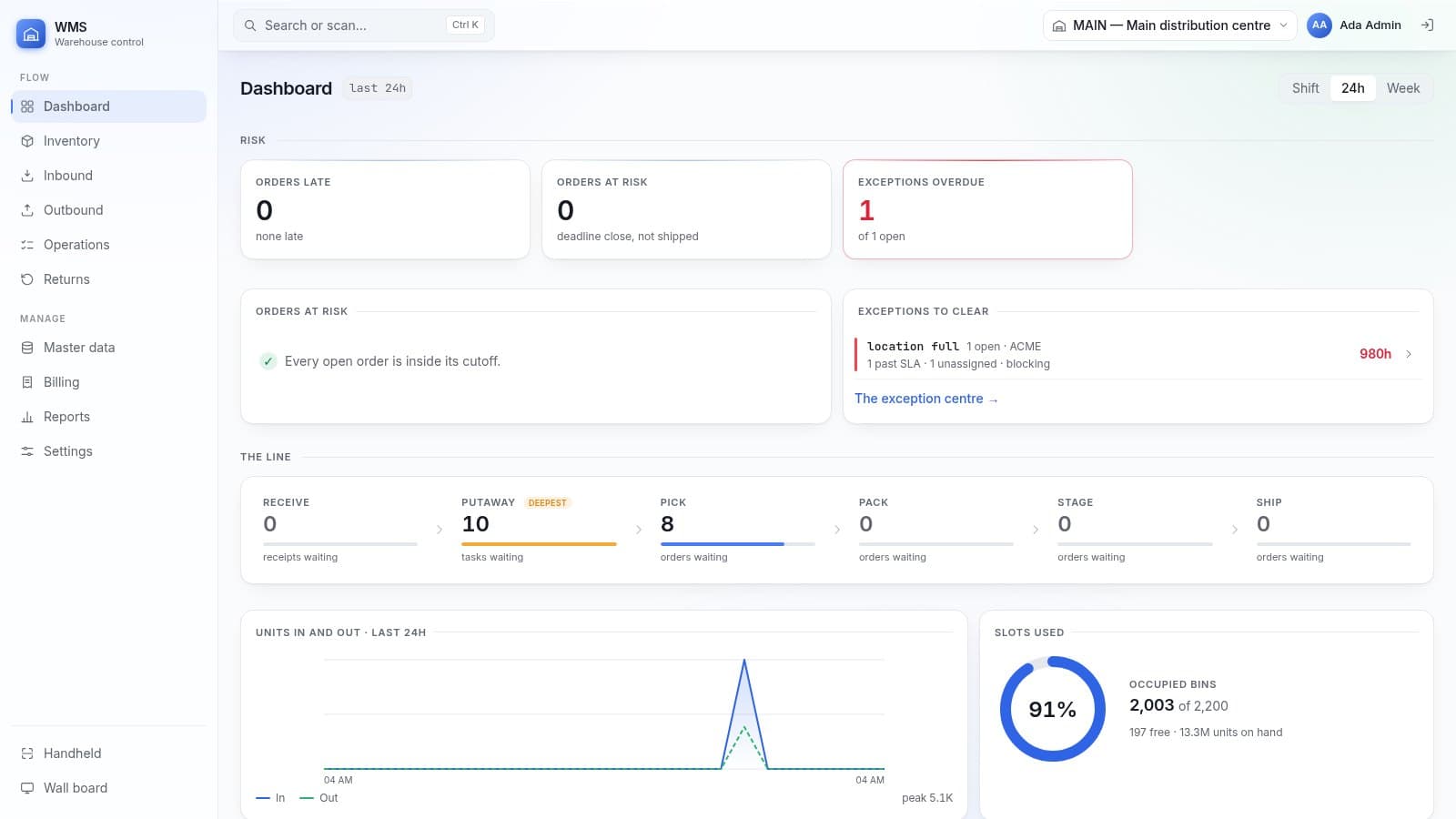
A self-hosted warehouse management system for a third-party logistics (3PL) business: one install runs several warehouses for several client companies, from the receiving dock to the truck, and each client only ever sees its own stock. The brief The goal was a WMS the business owns outright. It had to run on its own server, handle more than one warehouse and more than one client company from day one, and work with ordinary hardware: any keyboard-wedge barcode scanner and network Zebra label printers. No paid cloud service was allowed as a hard dependency. Carrier APIs, cloud storage and error tracking are optional add-ons, so the warehouse keeps working if a subscription lapses. The feature list was modelled on what the big platforms (Microsoft Dynamics 365, Oracle WMS, Manhattan) treat as basic: directed putaway, waves, license plates, replenishment, cycle counting, cross-docking, returns and labor tracking. A warehouse that has only "receive" and "pick" outgrows its software in a few months. What a normal day looks like in it Receiving: a truck arrives against a purchase order or ASN. The receiver scans each product on a handheld, enters lot and expiry where needed, and marks damaged units. The system creates a GRN and tells the putaway team which bin each pallet should go to, and why it picked that bin. Orders: client orders come in on screen or through the REST API. Stock is reserved and allocated with row locks, so two orders can never take the same units. Picking: orders are grouped into waves, and pick tasks are sorted in walking order through the aisles. Pickers get their next task on the handheld, scan the bin, scan the product, done. Packing and shipping: the packer gets a carton suggestion and a weight check, prints a Zebra label, and the shipment, manifest and bill of lading are produced from the same data. Supervisors watch it all on a live dashboard and a dark wall board on the warehouse TV, with an exceptions queue (short picks, full locations, damaged stock) that has owners and SLA timers. Clients log in to their own portal to check stock, orders, receipts and shipments, and pull their reports without emailing anyone. Three apps, one system The desk app is for office staff and supervisors: more than 60 screens covering master data, inbound, inventory, outbound, cycle counts, returns, 3PL billing, 16 reports and settings, with a Ctrl+K search that also accepts a barcode. The handheld app is built for gloved hands on a handheld scanner: one scan per screen, big buttons, loud error feedback, and actions queue up and sync when the Wi-Fi drops between racks. The client portal is a read-only window for each customer. The parts we were most careful about In a 3PL, the worst possible bug is one client seeing another client's stock. So the client filter is not something each screen remembers to add: it is injected into every database query by middleware, and a dedicated check script tries to break it. Stock can only change in one place in the code. Every movement is written to an append-only ledger (a database trigger refuses edits and deletes), balances are updated from that ledger, and a nightly job checks the two still agree. Quantities and money are fixed decimals, never floats. Database constraints refuse negative stock or allocating more than is on hand, even if the application code has a bug. Every change is in an audit trail linked by a hash chain, so you can tell if someone tampered with history. Double scans and double clicks happen all day on a warehouse floor. Every write carries an idempotency key, so the second one is ignored instead of receiving the same pallet twice. How it was tested There are 17 automated check suites. The most important one walks a real product through the whole warehouse over HTTP (receive, put away, allocate, wave, pick, pack, ship) and asserts that the ledger equals the balance at both ends. Another opens 84 screens in headless Chrome at handheld size and fails on any console error, failed request, sideways scroll or button smaller than a gloved thumb. We load-tested it with about 100,000 stock records and 130,000 ledger rows. The screenshots here are from a local run with demo data. Where it is now The software is finished and every check passes. The next step is user acceptance testing with real pickers on the warehouse floor, so it is not public yet. If you run a warehouse or a 3PL and want a walkthrough, get in touch .
- Next.js 16
- React 19
- TypeScript
- Tailwind CSS 4
- +13
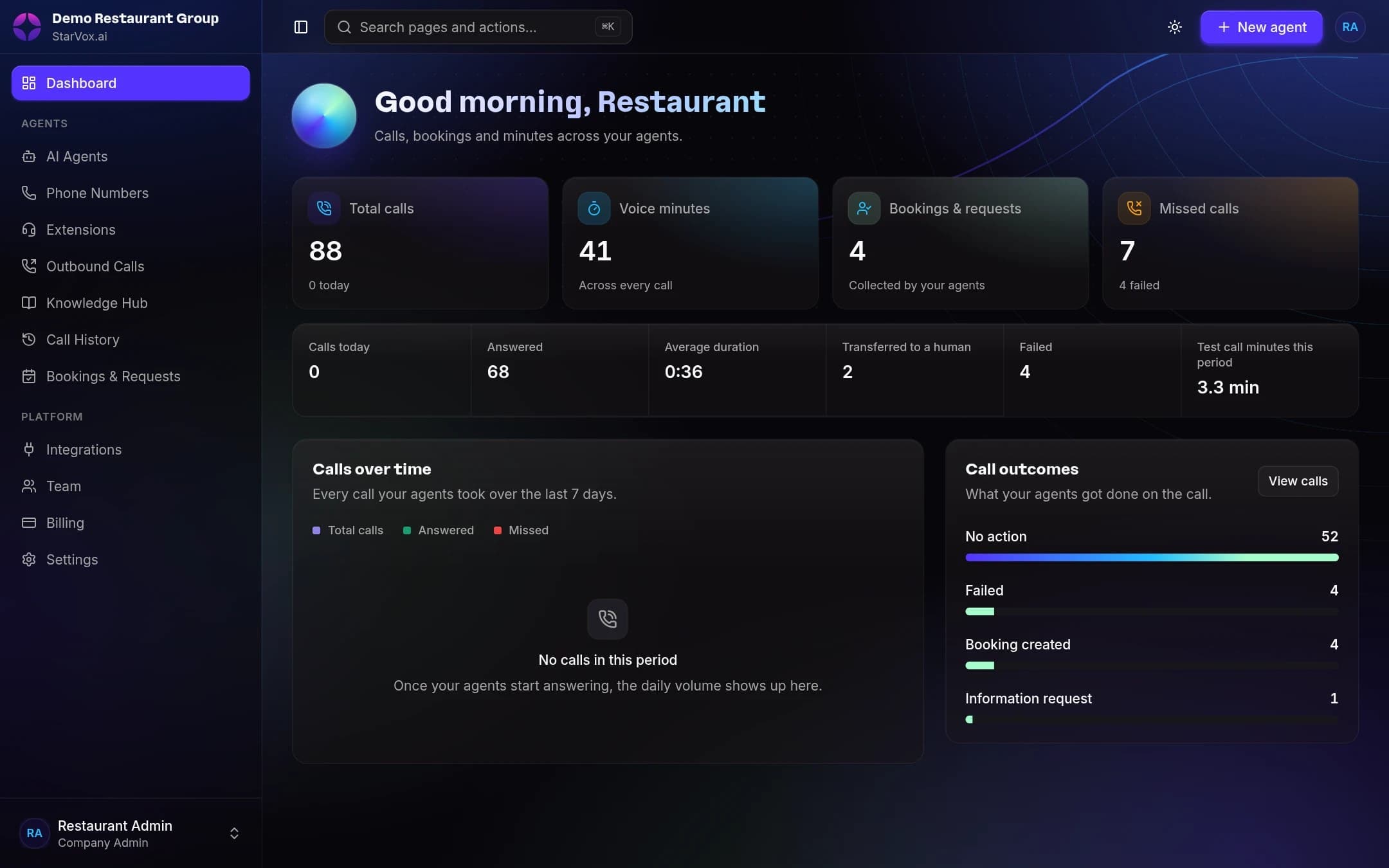
StarVox: AI Voice Agent Dashboard
StarVox is a multi-tenant SaaS dashboard where a business sets up an AI phone agent that answers every call, books appointments and logs each conversation. The brief The client wanted creating an AI telephone agent to feel like hiring an employee: answer five plain-English questions (what it should do, how it should speak, what it should know, which systems it connects to, which number it answers) and go live. Non-technical by default, with model and telephony settings tucked away behind an Advanced section. What I built I designed and built the whole web front end in Next.js 16 and React 19 against the client's real, deployed backend: around 110 API endpoints and no mock data. Every screen reads live data, and a screen whose API is not switched on yet says so instead of showing fake numbers. Dashboard: calls, voice minutes, bookings, missed calls, outcomes and a 7-day call chart. AI agents: greeting, system prompt, language and status, plus a Test call button that talks to the agent in the browser over LiveKit WebRTC. Voice picker: searches a catalog of 19,000+ ElevenLabs voices on the server, with language, accent and gender filters and one-click previews. Call history: recording, a turn-by-turn transcript, an AI summary and the details the agent pulled out of the call (date, time, party size, request type). Bookings and requests collected by the agents, ready for staff to action. Integrations: ERPNext, webhooks, WhatsApp (UltraMsg) and email, each with a test-connection button and a delivery log. Outbound campaigns: AI conversations or recorded voice broadcasts, with a do-not-call list. Self-service onboarding: sign-up, email verification, password reset, plan selection, Stripe checkout and a guided first-run tour. Super-admin area for companies, plans and billing across every tenant. Design and performance A custom purple/cyan brand system in Tailwind CSS 4 and shadcn/ui, in both light and dark mode. Motion is CSS-only (I dropped a JavaScript animation library that was slowing down page changes), fonts are trimmed to the weights actually used, every screen has its own page title, and only the public sign-in pages are indexable. Delivery Strict tenant isolation (the tenant comes from the login token, never from the browser), role-based screens for company admins and operators, and automated deployment from GitHub Actions to an Ubuntu server behind nginx.
- Next.js 16
- React 19
- TypeScript
- Tailwind CSS 4
- +9

Generative AI Software | AI Art Creation Tool | Miragic
Miragic.ai is a comprehensive Generative AI SaaS platform that empowers users to create stunning AI-generated content across multiple modalities. Built as a full-stack web application, it combines cutting-edge artificial intelligence technologies with an intuitive user interface to democratize creative AI tools for professionals and enthusiasts alike. The platform features six core AI-powered tools: AI Background Removal for instant image editing, Virtual Try-On for realistic clothing simulations, Speed Painting for AI-assisted artistic creation, Text-to-Image Generation for visual content creation, Sales Pilot for AI-driven business intelligence, and advanced audio processing with Text-to-Speech and Speech-to-Text capabilities. With a robust credit-based system, subscription management, and enterprise-grade security, Miragic.ai serves thousands of users globally, providing seamless access to state-of-the-art AI models while maintaining exceptional performance and user experience. Technologies Frontend: React 19, TypeScript, Vite, TailwindCSS 4, Radix UI, Framer Motion, React Router, Axios, Chart.js, Stripe.js, Socket.io Client Backend: Node.js, Express 5, TypeScript, Prisma ORM, PostgreSQL, Redis, BullMQ, Socket.io, Passport.js, Multer, Stripe, JWT, Winston Logging Infrastructure: Docker, Redis Caching, Rate Limiting, Security Middleware, File Storage, WebSocket Services, External AI APIs Development Tools: ESLint, Prettier, Husky, Git Hooks, Environment Management, Database Migrations, API Documentation Payment & Auth: Stripe Payments, Google OAuth, Apple OAuth, Email Verification, Password Reset, Credit Transactions AI Integration: External ML APIs, Form Data Processing, Async Job Processing, Real-time Updates, Error Handling
- React 19
- TypeScript
- Vite
- TailwindCSS 4
- +20

Used Phone Resale
I have created the Used Phones Resale project using npx create-react-app b612-used-products-resale-clients-side-rakibulinux and then install some npm packages like react-router, react-hot-toast, firebase, lottie-react, react-icons, react-router-dom, and react-to-pdf, to make my work perfect. Then created some components inside of the components folder also added a router file inside of the Routers folder. After this I focused on my API load and firebase authentication work. API loaded via react-router loader also used react context API to make my work faster.
- React JS
- React Router
- React Hot Toast
- React Context API
- +12
Process
From idea to production
A transparent, predictable process focused on shipping real value, not surprises.
- 1
Discovery call
Free consultation
We talk through your goals, users, timeline and budget, and I flag risks early.
- 2
Scope & quote
Written proposal
You get a written scope, milestones and a fixed price. No work starts until you agree.
- 3
Build & iterate
Regular check-ins
Small increments with regular check-ins, so you can see progress and steer early.
- 4
Launch & support
Handover + docs
Production deployment with monitoring, documentation and optional ongoing support.
Testimonials
What clients say
Straight from the people who hired me, including reviews left after paid orders.
5.0
out of 5
Based on 4 client reviews
- 54
- 40
- 30
- 20
- 10
4 from verified paid orders
“We need to make it perfect”
Verified order · AI Integration for Your App: Chatbots, RAG and MCP Servers
MD RAKIBUL ISLAM RAKIB Customer
“Awesome seller.”
Verified order · You will get your own cryptocurrency exchange software with OpenDax and Hummingbot
MD RAKIBUL ISLAM RAKIB Customer
“Again awesome service from the developer”
Verified order · You will get your own cryptocurrency exchange software with OpenDax and Hummingbot
MD RAKIBUL ISLAM RAKIB Customer
“Awesome Service”
Verified order · I will be your ReactJS Developer | Front End Web Developer | Figma to React
MD RAKIBUL ISLAM RAKIB Customer
FAQ
Questions, answered
Everything you need to know before we start.
What kind of projects do you take on?
SaaS products, business web apps, dashboards and APIs, plus DevOps and Linux work: deployments, CI/CD, server setup and maintenance. I take on new builds as well as existing codebases.
How much does a project cost?
It depends on scope. Fixed-scope packages with starting prices are listed on the Services page. For custom work I send a fixed quote after a free discovery call, so you know the price before any work starts.
How long does a typical project take?
Small fixes and deployments usually take days; a full web app or MVP takes weeks. Every proposal includes a timeline with milestones, so you know what ships when.
How do payments work?
We agree on scope and price first, and no advance is needed to start the conversation. Fixed-scope services can be paid securely online by card. Larger projects are split into milestones agreed up front.
Can you work on my existing codebase or servers?
Yes. I regularly fix bugs, improve performance, add features and migrate infrastructure on existing projects. We usually start with a short review so the estimate is based on the real code.
Do you work with clients outside Bangladesh?
Yes. I work remotely with clients worldwide, schedule calls around your time zone and reply to messages within 24 hours.
What happens after launch?
You get a handover with documentation and full access to your code, servers and accounts. Ongoing maintenance and support are available if you want someone to keep things running.
Free consultation · no commitment
Have a project in mind? Let's build it.
Tell me what you're building. I'll reply within 24 hours with next steps and a clear plan.
Or email rakibulinux@gmail.com