How to Get Cited by ChatGPT and AI Overviews in 2026
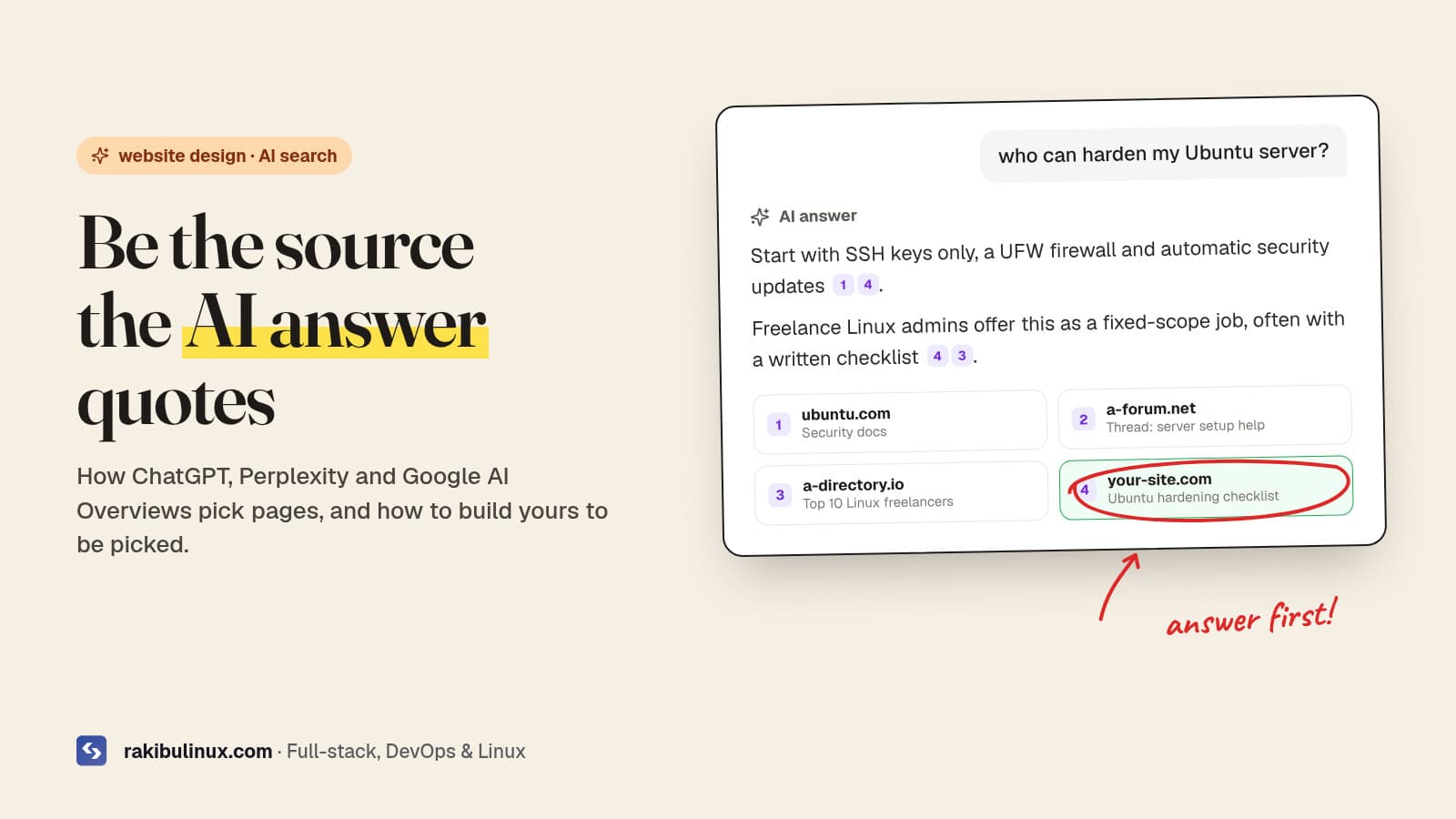
To get cited by ChatGPT and AI Overviews, be crawlable and indexed, answer the question in the first lines, and show real expertise. No special markup.
AI answers now sit above or in place of the ten blue links for many questions, and they quote a handful of pages. Being one of those pages is the new page one. I rebuilt this website with that goal: every blog post opens with a short, quotable answer, pages are server-rendered, AI search crawlers are allowed in, and there's an llms.txt file. Here is what actually matters for AI citations in 2026, what is hype, and how to design pages that get quoted.
Key takeaways
- Google says no special optimisation is needed for AI Overviews or AI Mode. Normal SEO and helpful content are the requirements.
- Each AI company runs separate bots for training, search and user fetches. You can block training and still allow search citations.
- Answer first. AI systems quote short, self-contained passages. Put a direct 1-2 sentence answer at the top of the page and under each heading.
- Server-render your content. Many AI crawlers don't run JavaScript, so text that only appears after hydration may be invisible to them.
- llms.txt is optional. It's cheap to add, but no major search engine has said it uses it for ranking.
How do AI answers choose which pages to cite?
The details differ by product, but the pattern is the same. The system turns your question into one or more searches, pulls candidate pages from a search index, extracts the passages that answer the question best, writes an answer from them and links the sources. So there are three gates:
- Be in the index. Google's AI features use Google's own index. ChatGPT search uses its own crawler (OAI-SearchBot) plus partners. Perplexity and Claude run their own search bots too.
- Be retrieved. That's classic relevance: the page matches the query and comes from a site the system trusts on the topic.
- Be quotable. The page contains a short passage that answers the question cleanly, without needing the rest of the page for context.
Most "GEO" advice is really about gate three. Gates one and two are still SEO.
Step 1: Let the right crawlers in
Check robots.txt and your firewall or CDN bot rules. AI companies split their bots by job:
- OpenAI:
OAI-SearchBot(ChatGPT search results),ChatGPT-User(fetches when a user asks),GPTBot(model training). - Anthropic:
Claude-SearchBot(search),Claude-User(user fetches),ClaudeBot(training). - Perplexity:
PerplexityBot(search) andPerplexity-User. - Google: AI Overviews and AI Mode use normal
Googlebot.Google-Extendedcontrols use in Gemini training and some other Google AI products, not Search.
If you don't want your content used for training but do want citations, block the training bots and allow the search bots:
User-agent: GPTBot
Disallow: /

User-agent: ClaudeBot
Disallow: /

User-agent: *
Allow: /
Disallow: /admin/
Sitemap: https://www.example.com/sitemap.xml
Also check Cloudflare or your WAF. "Block AI bots" toggles often block the search bots too.
Step 2: Make content readable without JavaScript
Googlebot renders JavaScript. Many other crawlers fetch only the raw HTML. If your article text is loaded client-side, test it: run curl -s https://your-site.com/page | grep "a sentence from the page". If the sentence isn't there, render on the server. Next.js server components, Astro and plain HTML all pass. A Vite single-page app usually fails, which is one more reason to move AI-built prototypes to a server-rendered stack (see taking a Lovable app to production).
Step 3: Write in answer-first blocks
This is the part that's actually design work. Structure each page so any section could be quoted on its own:
- First paragraph = the answer, 1-2 sentences, under about 160 characters. It doubles as your meta description.
- Question-shaped headings that match how people ask ("How much does X cost?"), each followed by a direct answer and then the detail.
- Specific facts: version numbers, commands, steps, prices with dates. Vague prose is hard to quote.
- Lists for steps and comparisons, short paragraphs, one idea per section.
- An FAQ block with real follow-up questions.
Every post on this blog uses that pattern. My Ubuntu hardening checklist is a typical example.
Step 4: Prove you know the subject
AI systems lean on the same trust signals as search: who wrote this, are they qualified, does the site specialise in it. In practice:
- An author name with a real about page, links to your GitHub or LinkedIn, and consistent details everywhere you're listed.
- First-hand detail: "this exact config runs this site", screenshots, real output, mistakes you made.
- Structured data that describes the page truthfully:
Article,Person,Organization,FAQPagewhere it fits. Google says no special schema is required for AI features, but correct schema helps engines understand who and what the page is about. - Mentions elsewhere: answers on forums, guest posts, directories and reviews. AI answers often cite third-party pages that mention you, not only your own site.
Step 5: Add llms.txt (optional)
llms.txt is a proposed Markdown file at your site root that summarises the site and links the key pages for language models. It takes ten minutes, so this site has one. Keep expectations low: Google's guidance on AI features doesn't mention it, and you shouldn't expect it to change rankings by itself.
Step 6: Measure it
Search Console added generative AI performance reporting in 2026, so check there first for Google. For ChatGPT and Perplexity, look in your analytics for referrals from chatgpt.com and perplexity.ai, and search your target questions in each tool every month. Note which pages get cited and copy their structure.
What doesn't work
- Hidden text or prompts aimed at AI crawlers. It's spam, and engines treat it that way.
- Mass-produced AI articles with no first-hand detail. They don't get cited because they add nothing new.
- Special "AI schema" or meta tags sold as a shortcut. No major engine has announced any.
Frequently asked questions
What is GEO (generative engine optimization)?
GEO means making content easy for AI answer engines to find, trust and quote. In practice, it's SEO plus answer-first writing, server-rendered pages and crawler access for AI search bots.
Does blocking GPTBot remove me from ChatGPT search?
No. GPTBot is OpenAI's training crawler. ChatGPT search uses OAI-SearchBot, which you control separately in robots.txt.
Do I need llms.txt to appear in AI answers?
No. It's an optional proposal. Crawlability, clear answers and authority matter far more.
How long does it take to get cited?
About as long as ranking does. New pages on an established site can appear within weeks of being indexed. New sites need time to build trust, just as with classic SEO.
Can a small business site get cited over big brands?
Yes, for specific questions. AI answers often cite the most direct, detailed page, not the biggest site. Narrow, expert pages beat generic ones.
Want a site that AI answers can quote?
I design and build fast, server-rendered websites with answer-first content structure, clean metadata and structured data built in. See my website design services or ask for a quick audit of your current site.
- AI search optimization
- GEO
- AI Overviews
- ChatGPT search
- llms.txt
- SEO
- website design